
Dogs · 8 min read
Dogs Scared of Thunderstorms and Fireworks: What Actually Helps
Noise phobia is progressive. Left untreated, a dog who was mildly unsettled by thunder at two is often terrified of the rain that precedes it by five, and that spread is the part most pet parents do not see coming.
By Dr. Rachel Malamed, DVM, DACVB , veterinary psychiatrist, board-certified in veterinary behavior medicine
The short version
- Noise phobia rarely stays still. It generalizes to whatever reliably predicts the noise.
- Comforting a frightened dog does not reinforce fear. You cannot reward an emotion.
- Panic during an event is an emergency to be managed, not a training opportunity.
- Noise phobia and pain travel together surprisingly often, especially in older dogs.
- Preparation happens in the quiet weeks, not on the night of the storm.
Fear of noise is a medical condition, not a quirk
A dog who trembles through a thunderstorm is not being dramatic. Noise aversion produces measurable physiological stress: elevated cortisol, elevated heart rate, and a fully engaged fight-or-flight response to a stimulus the dog cannot escape or predict. Some dogs hide, some pace and pant, some destroy doorways trying to get out, and some go very still, which is the version most likely to be mistaken for coping.
It is also common. Surveys consistently find that a large minority of dogs show fear of loud noises, and that most of those dogs never get treated, usually because the fear is read as personality rather than pathology.
Why it gets worse year after year
Two mechanisms drive the progression. The first is sensitization: repeated exposure to something genuinely frightening, with no way to escape and no resolution, makes the response stronger rather than weaker. The opposite of what people expect from 'getting used to it'.
The second is generalization. The dog learns what predicts the noise. Darkening skies, a drop in barometric pressure, the smell of rain, the neighbors setting up in the yard, the first distant pop three streets away. Within a couple of seasons the fear starts long before the noise does, which is why pet parents so often say the dog 'knows before we do'.
The advice that does not hold up
"Don't comfort them, you'll reinforce the fear"
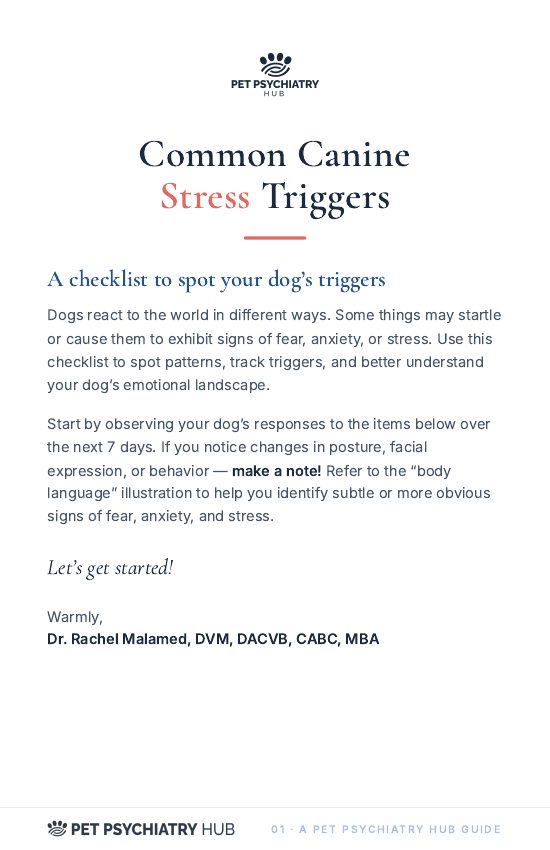
Free companion guide
Common Canine Stress Triggers
A 7-day checklist to find the patterns behind your dog's stress.
Get the free guideThis is the most persistent myth in the field and it is wrong. Reinforcement applies to behavior, not to emotional states. You cannot make a dog more afraid by being present, calm, and available. If your dog seeks you out during a storm, let them, and stay unremarkable about it. What you want to avoid is your own anxiety, not your presence.
"Just expose them to fireworks recordings"
Sound desensitization can work, but only when the volume genuinely stays below the dog's reaction threshold and the sessions are paired with something good. Played at a level that already worries the dog, it is not desensitization, it is repeated exposure, and it makes things worse. Recordings also lack the pressure changes, vibration, and flashes that many dogs are actually responding to.
"Wait and see, they will grow out of it"
They typically do not. Untreated noise phobia usually intensifies with age, and the older dog is often the harder case, because by then the fear has spread across a wide set of triggers.
What I actually do
Rule out pain first
There is a well-documented association between noise aversion and musculoskeletal pain, particularly in dogs whose fear appeared or worsened in middle age. A dog with new-onset noise phobia over the age of about six gets an orthopedic assessment before anything else.
Build a refuge before the season
Most dogs pick their own place. An interior room, a bathroom, a closet, under a bed. Your job is to make the choice good rather than to choose for them: soft bedding, an open door so it never becomes a trap, sound masking from a fan or white noise, windows covered so flashes do not reach in, and something high-value to chew that is only available there. Set it up in the quiet weeks so it already feels ordinary.
Treat the panic itself
For dogs whose fear reaches genuine panic, situational medication given before the event, not after the shaking starts, is the difference between a bad night and a night that adds another layer of sensitization. There are medications developed specifically for canine noise aversion, and your veterinarian can advise on what suits your dog's health profile. Dogs with year-round, generalized noise fear may also benefit from a daily medication underneath.
Give the medication when the forecast says storm, not when the dog says storm. Once panic is running, you are chasing it.
The one tactic to start with
Keep a simple trigger log for a month: date, what the noise was, what the dog did, how long recovery took. Two things come out of it. You find out how far the fear has generalized, which is almost always further than expected, and you get an objective baseline, so that next season you can tell whether the plan is working rather than relying on memory of a stressful night.
That log is also the most useful thing you can hand a veterinarian. It turns 'he hates fireworks' into a pattern that can be treated.
© 2026 Rachel Malamed, DVM · Pet Psychiatry Hub. This content may not be reproduced without permission.