
Dogs · 9 min read
Dog Separation Anxiety: Why Most Advice Fails
Separation anxiety is a panic disorder, not a manners problem. Once you see it that way, most of the standard advice stops making sense, and the treatment that does work starts to.
By Dr. Rachel Malamed, DVM, DACVB , veterinary psychiatrist, board-certified in veterinary behavior medicine
The short version
- True separation anxiety is panic. The dog is not bored, spiteful, or under-exercised.
- Not every dog who makes noise when alone has it, the distinction changes the plan entirely.
- Crating a panicking dog often intensifies the panic and causes injury.
- Progress depends on one uncomfortable principle: reducing how often the dog rehearses the panic.
What it actually is
Separation-related distress is a panic response triggered by being alone, or by being separated from one specific person. It is closer to a human panic attack than to any training issue. The physiological picture is the same: racing heart, hypersalivation, loss of bladder or bowel control, frantic attempts to escape, and an inability to eat even highly valued food.
That last detail is a useful diagnostic. A bored dog will happily work a food toy. A panicking dog will not touch it. If the stuffed Kong comes back untouched every single time, you are not dealing with boredom.
It matters that this is involuntary. The dog is not weighing the consequences of chewing the door frame. There is no decision being made, which is why every approach premised on the dog making a better choice fails.
Not every dog who protests is panicking
This is the most consequential distinction in the whole subject, and it gets skipped constantly. Several quite different problems produce a noisy or destructive dog when the pet parent leaves, and they need different plans.
- True separation anxiety, panic at being alone at all
- Isolation distress, distress at being alone, relieved by the company of anyone, including another dog
- Hyper-attachment to one person, the dog is fine with the family but panics without a specific individual
- Confinement distress, the dog is fine alone in the house and panics in the crate; the crate is the trigger, not the absence
- Boredom and under-stimulation, destruction that is exploratory, spread through the day, and stops when the dog is given something to do
- Noise phobia, the dog is not distressed by your absence but by what happens outside while you are gone
- Incomplete house-training or a medical cause behind the soiling
Treating confinement distress as separation anxiety will fail permanently, because the answer is simply to stop using the crate. Treating boredom as panic will fail too. The way to tell them apart is not to guess, it is to record.
Why the standard advice backfires
“Tire them out with a long walk first.”
Exercise is good for dogs and it is not a treatment for panic. A physically exhausted dog still panics; it simply panics while tired. Worse, in some dogs a strenuous walk immediately before departure leaves them physiologically aroused rather than settled, and the departure lands on top of that.
Free companion guide
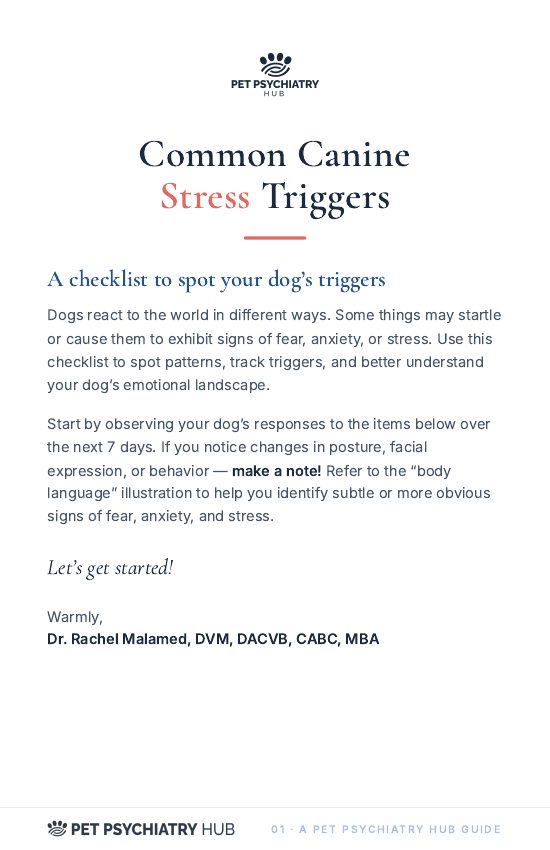
Common Canine Stress Triggers
A 7-day checklist to find the patterns behind your dog's stress.
Get the free guide“Crate them so they can’t destroy anything.”
This is the advice that causes the most harm. Confining a dog who is panicking about being trapped and alone frequently escalates the panic dramatically. The injuries I see from this are real, broken teeth, torn nails, lacerated gums from biting bars. The house is protected and the dog is considerably worse. For some dogs a crate is a genuine refuge; for a dog in separation panic, it is far more often a trap.
“Ignore them completely when you leave and come home.”
Undramatic departures are sensible. Cold, deliberate ignoring of a distressed dog is not, and it does nothing to address a panic response that begins long before you reach the door. The dog’s anxiety is not being caused by an affectionate goodbye.
“Get a second dog to keep them company.”
Occasionally this helps isolation distress. For true separation anxiety, where the attachment is to you, it usually does nothing, and you now have two dogs, one of whom may learn the behavior from the other.
The principle that actually drives progress
Every effective protocol, whatever its details, rests on one thing: the dog must stop rehearsing the panic. Each episode of full-blown distress strengthens the association between your departure and terror. A dog who panics for four hours every weekday is practicing panic twenty hours a week, and no amount of good work at the weekend outruns that.
You cannot desensitize a dog to something they are still being flooded with. Reducing exposure is not avoidance, it is the precondition for treatment working at all.
This is why the management side, daycare, a sitter, a neighbor, working from home, adjusted schedules, is not a stopgap while you wait for the “real” training. It is what makes the real training possible. Pet parents often resist this because it feels like giving in. It is the opposite: it is the part that determines whether anything else works.
One thing you can do this week
Break the meaning of your departure cues. Your dog’s anxiety does not start at the door, it starts when you pick up the keys, put on shoes, or close a laptop, because those reliably predict absence.
So do them without leaving. Pick up the keys, sit down and watch TV. Put your coat on, make a cup of coffee, take it off. Open the front door, close it, stay. Repeat many times a day, at random, until the cues stop predicting anything.
This is genuinely useful on its own and it is deliberately not the whole plan. It weakens the cues; it does not treat the underlying panic about the absence itself. That requires graduated absence work, built around your dog’s actual threshold, adjusted every time it stalls, and that sequencing is the part that needs a structure.
Where medication fits
Medication is neither a failure nor a shortcut. For a dog in genuine panic, appropriate medication lowers the baseline enough that the dog can begin to learn, and a dog who cannot learn cannot be trained out of anything. In severe cases, behavior work without pharmacological support simply does not get traction.
It is a prescription decision, made with a veterinarian, based on the individual dog. The important correction to the popular framing is that it is not a last resort after everything else has failed. Used early in the right cases, it is often what makes everything else succeed.
© 2026 Rachel Malamed, DVM · Pet Psychiatry Hub. This content may not be reproduced without permission.