
Dogs · 7 min read
The Puppy Socialization Window: What Matters and What Doesn’t
There is a narrow window early in a puppy’s life when the brain is unusually willing to file new experiences as normal. Most pet parents spend it worrying about house-training.
By Dr. Rachel Malamed, DVM, DACVB , veterinary psychiatrist, board-certified in veterinary behavior medicine
The short version
- The sensitive period runs roughly to 12–14 weeks and does not reopen.
- Quality beats quantity, a bad experience during this window teaches faster than a good one.
- Waiting for full vaccination before any socialization is now advised against by veterinary bodies.
- The goal is a puppy who finds the world unremarkable, not one who has met a hundred people.
Why this period is different
For a few weeks in early puppyhood, the developing brain treats novelty as information rather than as threat. New sounds, surfaces, people, and situations get cataloged as part of how the world simply is. The window opens at around three weeks, largely the breeder’s responsibility, and begins closing from about twelve weeks, with individual and breed variation.
After it closes, the default flips. Novel things are now suspicious until proven otherwise, and teaching a dog that something is safe becomes slow, deliberate work rather than a by-product of ordinary exposure. This is why adult dogs can absolutely learn to cope with things they never met young, but it takes months of structured effort to achieve what a two weeks would have done at ten weeks.
What genuinely needs covering
Pet parents tend to over-index on other dogs and people, and under-index on almost everything else. A broader list, roughly in order of how often it turns up as an adult problem:
- Handling, paws, ears, mouth, tail, collar grabs, being lifted, being held still
- Veterinary contexts, the building, the table, the smell, restraint, brief examination
- Grooming equipment, clippers, brushes, nail trimmers, running water, the dryer
- Surfaces, grates, tile, gravel, wet grass, stairs, anything that moves or echoes underfoot
- Sounds, traffic, thunder recordings, fireworks recordings, vacuums, doorbells, smoke alarms
- People who look and move differently, hats, beards, uniforms, sticks, wheelchairs, children
- Being alone, short, gradual, entirely separate from house-training
- Car travel, in short and pleasant doses
- Calm, appropriate adult dogs, not chaotic free-for-alls with other puppies
How this window gets wasted
Waiting until the vaccine course is finished
By the time a puppy is fully covered, most of the window has gone. Veterinary behavior bodies have addressed this directly: the behavioral risk of under-socialization outweighs the controlled infectious risk. The answer is to socialize carefully rather than to wait, carry the puppy, use clean private homes, choose well-run puppy classes that require age-appropriate vaccination, and avoid dog parks and heavily trafficked public ground. Speak to your own veterinarian about local disease risk.
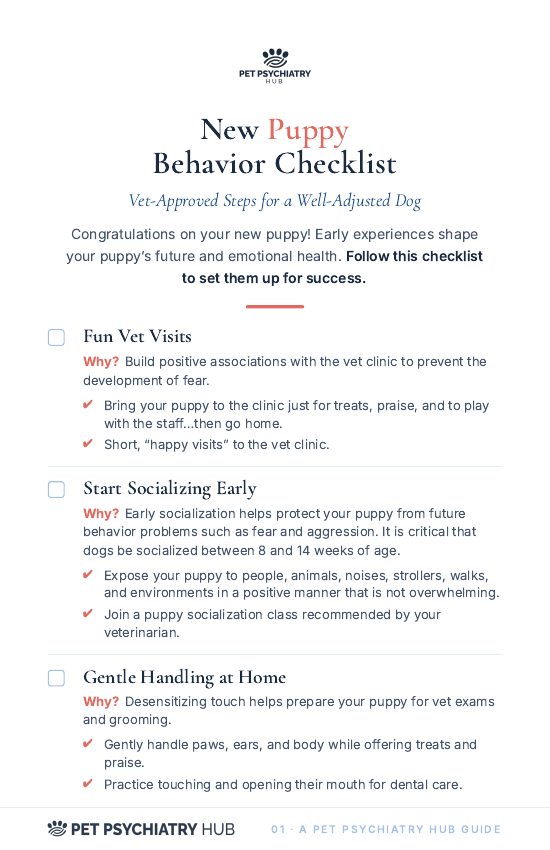
Free companion guide
New Puppy Behavior Checklist
Vet-approved steps for a well-adjusted dog, starting in the critical window.
Get the free guideTreating it as an endurance test
The busy market, the crowded café, the group of enthusiastic children, these are commonly recommended and commonly too much. A puppy who is overwhelmed is not being socialized, they are being sensitized. Watch for the signals: freezing, tail tucked, refusing food, trying to get behind you. When you see them, increase distance immediately. There is no benefit in pushing through.
Puppy parties with no supervision
A well-run class is one of the best investments you can make. A room of puppies left to sort it out teaches the bold ones to bully and the timid ones that other dogs are frightening, and both lessons stick.
One thing you can do this week
Run a handling minute, twice a day. Sit with your puppy somewhere calm, with something they like to eat. Touch one paw, feed. Look briefly in one ear, feed. Lift a lip, feed. Hold the collar for a second, feed. Stop well before they want you to.
It takes sixty seconds and it pays back for the dog’s whole life. Handling tolerance is the single most useful thing you can install early, because it touches every veterinary visit, every nail trim, every emergency examination, and every grooming appointment for the next fifteen years.
If the window has already closed
Plenty of dogs arrive as adolescents or rescues with none of this behind them, and that is not a lost cause. The work changes character rather than becoming impossible: you are now building new associations deliberately, at a controlled intensity, over months rather than weeks. Adult dogs learn, they simply need the process designed rather than absorbed.
What does not work in either case is hoping the dog will “get used to it” through ordinary life. Repeated exposure to something frightening, without structure, entrenches the fear rather than dissolving it.
© 2026 Rachel Malamed, DVM · Pet Psychiatry Hub. This content may not be reproduced without permission.