
Dogs & Cats · 7 min read
What Is a Veterinary Behaviorist (Veterinary Psychiatrist)? And When Do You Need One?
“Behaviorist” is not a protected term, anyone can use it. A board-certified veterinary behaviorist is something much narrower: a veterinarian who completed a residency in behavior medicine and passed the board examination of the American College of Veterinary Behaviorists. Here is what that means in practice, and when it is the referral your pet actually needs.
By Dr. Rachel Malamed, DVM, DACVB , veterinary psychiatrist, board-certified in veterinary behavior medicine
The short version
- A veterinary behaviorist is a veterinary specialist, DVM plus a residency plus board certification (DACVB).
- “Veterinary psychiatrist” is the plain-language version of the same role, and describes the work more accurately for most pet parents.
- Trainers, CPDTs, and CAABs do valuable work, but only a veterinarian can diagnose disease and prescribe medication.
- Medication is one tool inside a behavior plan, never a replacement for one.
- Aggression, self-injury, sudden behavior change, and problems that have not responded to good training all warrant a referral.
The short definition
A board-certified veterinary behaviorist is a veterinarian who has been credentialed as a specialist in behavior medicine by the American College of Veterinary Behaviorists. The credential appears after the name as DACVB, Diplomate of the ACVB. There are roughly one hundred of us worldwide.
I usually describe myself as a veterinary psychiatrist, because that is what the work is. I diagnose and treat mental health conditions in animals, anxiety disorders, phobias, compulsive disorders, aggression arising from fear or pain, and cognitive decline in older pets, using a combination of behavior therapy, environmental change, and, where it is warranted, medication.
The training path
Board certification is not a weekend course or a paid membership. The path runs: a four-year veterinary degree, then clinical practice, then a formal residency in behavior medicine under an existing Diplomate, then published case reports and a peer-reviewed publication, and finally a two-day board examination with a pass rate that keeps the specialty small.
The practical consequence is that a veterinary behaviorist is trained in both halves of the problem, the medicine and the behavior. That matters because in a real case those halves are rarely separable.
How this differs from a trainer or a certified animal behaviorist
This is the single most common source of confusion, and it costs families months. The titles sound interchangeable and they are not.
- Dog trainer, teaches skills and manages behavior. Excellent trainers are indispensable, and I refer to them constantly. The title itself is unregulated, so credentials vary enormously.
- CPDT-KA / KPA-CTP and similar, certified trainers who have met a testing and experience standard in training methodology. Still training, not medicine.
- CAAB / ACAAB, Certified Applied Animal Behaviorists hold a PhD or master's in animal behavior. Strong behavioral science background; not veterinarians, so they cannot diagnose medical disease or prescribe.
- DACVB, a veterinarian and a specialist. Can examine, order diagnostics, diagnose medical and behavioral conditions, and prescribe.
None of these roles is a ranking of competence. They are different jobs. The question is not who is best, it is which one your case requires, and if there is any possibility that a medical problem is driving the behavior, that answer includes a veterinarian.
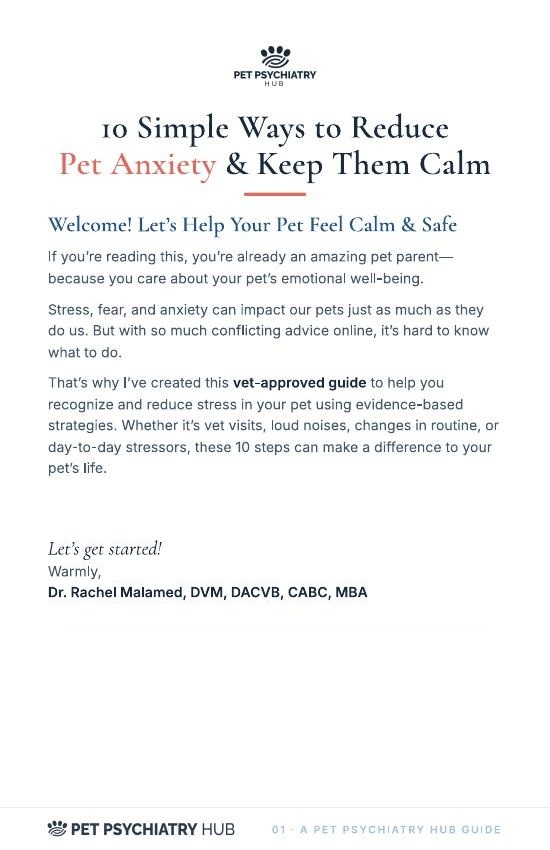
Free companion guide
10 Simple Ways to Reduce Pet Anxiety
Vet-approved, evidence-based steps to help your pet feel calm and safe.
Get the free guideWhere medication fits
Medication is one tool, and it is neither a shortcut nor a last resort. A brain that is stuck in a chronic stress state cannot learn well, the same physiology that produces the anxiety also suppresses the flexible learning that behavior modification depends on. In those cases medication is not sedating the animal into compliance; it is lowering the arousal enough that the behavior work can actually take.
Just as importantly: medication without a behavior plan is not treatment. If a pet has been put on a psychoactive medication with no diagnosis, no plan, and no follow-up, that is worth revisiting, that is precisely the kind of case a specialist is for.
When to ask your veterinarian for a referral
Ask for a referral to a board-certified veterinary behaviorist if any of the following apply:
- Any aggression, toward people, toward other animals in the home, or on walks, regardless of how minor it currently seems.
- Behavior that is escalating in frequency, intensity, or the range of triggers that set it off.
- A sudden change in behavior in an adult or senior pet, especially alongside changes in sleep, appetite, mobility, or toileting.
- Self-injury, or compulsive behavior such as flank sucking, spinning, fly-snapping, or overgrooming.
- Distress when left alone that has not improved with a well-run plan.
- A problem that a competent, reward-based trainer has worked on without meaningful progress.
- Anyone has suggested that rehoming or euthanasia may be on the table.
You generally do not need a formal referral to book, but keeping your primary veterinarian involved is not optional in my view. Behavior medicine works alongside general practice, not instead of it, and your vet holds the medical history that makes the assessment accurate.
What to expect from the appointment
An initial consultation with me runs 1.5 hours, because a real behavioral history takes that long: how the problem started, what precedes it, what has been tried, how the household is arranged, and what the pet's medical record shows. From that comes a diagnosis and a written treatment plan built around your actual household rather than a generic protocol.
If the wait for a specialist is long, and it usually is, because there are only about a hundred of us, that time is not wasted. Understanding what is happening to your pet, and starting on trigger management, changes outcomes before the first appointment ever happens.
© 2026 Rachel Malamed, DVM · Pet Psychiatry Hub. This content may not be reproduced without permission.