
Cats · 9 min read
Cat Behavior Problems: What They Actually Mean
Cats are read as spiteful, aloof, or untrainable far more often than dogs are, and almost none of that is accurate. Nearly every cat behavior problem I see is a cat responding sensibly to pain, to a home that does not meet feline needs, or to social pressure the household cannot see.
By Dr. Rachel Malamed, DVM, DACVB , veterinary psychiatrist, board-certified in veterinary behavior medicine
The short version
- Cats hide illness well, so a new behavior problem in an adult cat is a medical question first.
- Most household cat problems trace back to resources: how many, where they are, and who controls access.
- Cats do not act out of spite. Spite requires a theory of your mind that cats do not have.
- Punishment reliably worsens feline problems, because stress is a direct cause of most of them.
Why cats get misread
Dogs were shaped over thousands of years to broadcast their internal state to us. Cats were not. A cat's distress signals are small, brief, and easy to miss: a tail tip flicking, ears rotating back, a body held slightly lower than usual, a cat who has quietly stopped using the top of the stairs. By the time a cat swats, sprays, or hides for a day, the problem has usually been running for weeks.
Layer on top of that a species that evolved as both predator and prey. Hiding weakness is not optional for a cat, it is protective. That is why cats with painful arthritis or dental disease often present to me as behavior cases rather than medical ones. The pain never showed. The behavior change did.
The medical layer comes first, always
Before any behavior plan, a cat with a new or changed behavior needs a veterinary workup. This is not a formality. In feline medicine the overlap between medical and behavioral presentation is unusually large.
- House soiling: urinary disease, feline idiopathic cystitis, kidney disease, diabetes, hyperthyroidism, arthritis, constipation
- New aggression or intolerance of handling: dental pain, arthritis, ear disease, hyperthyroidism, hypertension
- Night-time yowling in an older cat: hyperthyroidism, hypertension, vision loss, cognitive decline
- Over-grooming to the point of bald patches: skin disease, parasites, pain referred from underneath
- Sudden hiding, appetite change, or withdrawal: almost anything, and worth taking seriously quickly
The four problems I see most
1. House soiling
The leading behavioral reason cats lose their homes, and the most fixable. It splits into marking (a communication problem, usually social stress) and toileting outside the box (a medical problem or an unacceptable box). Those two have almost nothing in common except the mess, so the first job is telling them apart.
2. Aggression toward people
Nearly always fear or pain, occasionally play or petting-related overstimulation. The cat who bites after ten seconds of stroking is not treacherous. Most cats have a fairly narrow tolerance for sustained contact, and many will show two or three small warnings, a skin twitch, a tail thump, a head turn, before the bite. Pet parents are usually startled because they missed the warnings, not because there were none.
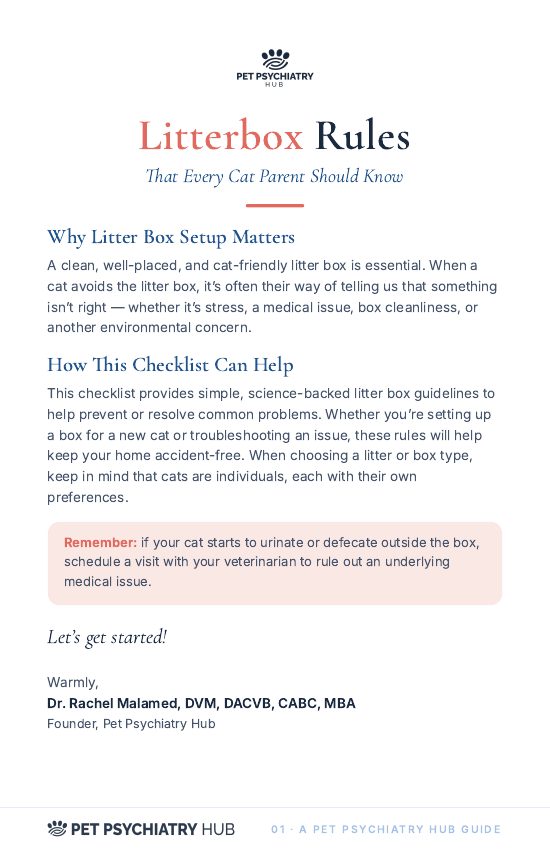
Free companion guide
Litterbox Rules Every Cat Parent Should Know
Science-backed setup rules that prevent most house-soiling problems.
Get the free guide3. Tension between cats in the same home
Cats are social, but on their own terms. They form relationships selectively and they do not naturally share core resources. Most multi-cat conflict is not a personality clash, it is a geography problem: too few resting places, food and litter clustered in one area, or one cat controlling a corridor the other needs to cross.
4. Night activity, yowling, and destructiveness
In young cats this is usually unmet predatory need. A cat's natural pattern is many small hunts a day, and a bowl of food left down all day removes every part of that sequence except swallowing. In older cats, night yowling is a medical flag until proven otherwise.
The invisible cause: resource geography
If I could change one thing in most households, it would be this. Cats need independent access to everything that matters, without having to pass another cat, a dog, a doorway, or a person to reach it. That means food, water, litter, resting places, hiding places, and vertical height, all distributed rather than clustered.
- Litter boxes: one per cat plus one, in separate locations, uncovered, and large
- Feeding stations: separated, ideally out of sight of one another, never a shared bowl
- Vertical space: shelves, cat trees, and clear routes up, so a cat can leave without crossing the floor
- Hiding places: at floor level and at height, always available, never blocked
- Escape routes: no dead ends, particularly in rooms with a litter box
Most of the cat cases I see are not behavior problems at all. They are architecture problems, wearing a behavior costume.
Why punishment backfires in cats specifically
Spray bottles, shouting, scruffing, and shutting a cat in a room all work on the same mechanism: they raise stress. Stress is a direct cause of feline idiopathic cystitis, a direct cause of spraying, and a direct cause of defensive aggression. So punishment tends to amplify precisely the behavior it targets, and it damages the cat's association with you at the same time. The cat does not conclude 'I should not do that.' The cat concludes 'this environment, or this person, is unpredictable.'
Medication, honestly
Medications are often used to help alleviate anxiety and improve a cat's welfare. In feline cases they are particularly valuable, because so many cat problems, cystitis, spraying, inter-cat tension, are stress-driven at their root. Medication does not replace changing the environment. It lowers the arousal enough that the environmental work can actually take hold, and it shortens the time an animal spends distressed.
One thing to do this week
Draw a rough floor plan of your home and mark every resource: each litter box, food and water station, bed, cat tree, and hiding spot. Then mark where each cat actually spends their time and where the friction happens. Households usually discover that everything important is on one floor, in two rooms, and that one cat has quietly stopped using half the house.
That map is the single most useful thing you can bring me. It converts 'they just do not get along' into a specific problem with a specific fix.
When to bring in a veterinary behaviorist
If the medical workup is clean, the setup has been corrected, and the problem persists, or if there is injury, sustained fear, or a household seriously considering rehoming, that is the point where a specialist consult is worth it. What we do at that stage is diagnose the underlying emotional state, treat it medically where appropriate, and build a plan around this cat and this house rather than cats in general.
© 2026 Rachel Malamed, DVM · Pet Psychiatry Hub. This content may not be reproduced without permission.