
Cats · 8 min read
Why Your Cat Is Peeing Outside the Litter Box
It is almost never spite, and it is almost never untrainability. In most cases it is a medical problem, a setup problem, or a social problem, and all three are addressable.
By Dr. Rachel Malamed, DVM, DACVB , veterinary psychiatrist, board-certified in veterinary behavior medicine
The short version
- See a veterinarian first. Urinary disease is common, painful, and can be an emergency in male cats.
- Marking and toileting are different behaviors with different causes and different solutions.
- Most setup failures come down to too few boxes, wrong location, or over-cleaning with the wrong products.
- Punishment reliably makes house soiling worse by adding anxiety to an already anxious cat.
Rule out the body before anything else
A remarkable proportion of house-soiling cases are medical, and the logic from the cat’s side is simple: if urinating hurts, and it hurts in the box, the box becomes the thing that hurts. The cat then looks for somewhere that might not. Cool tile, a bath, a soft pile of laundry.
- Feline idiopathic cystitis, extremely common, painful, and strongly stress-linked
- Urinary crystals, stones, or infection
- Kidney disease, diabetes, or hyperthyroidism, all of which increase urine volume
- Arthritis, an older cat may simply be unable to climb comfortably into a high-sided box
- Cognitive decline in senior cats
- Constipation or colitis for faecal soiling
No behavior plan should start before a urinalysis. Working on the litter box arrangement while a cat has cystitis wastes weeks and leaves an animal in pain.
Marking or toileting? They are not the same problem
Getting this wrong sends people down the wrong road entirely, and the two are easy to tell apart once you know what to look at.
Spraying (marking)
- Cat stands, tail upright and quivering, backing up to a vertical surface
- Small volume, deposited at nose height on walls, doors, curtains, or furniture edges
- Locations are socially significant, near windows, doors, or a new object in the home
- The cat still uses the litter box normally for everything else
- It is communication, driven by social stress: a new cat, a cat outside, a change in the household
Inappropriate toileting
- Cat squats, full bladder emptied on a horizontal surface
- Soft, absorbent locations, rugs, beds, laundry, bath mats
- The box is being avoided or used inconsistently
- It is elimination, driven by a medical problem or an unacceptable box
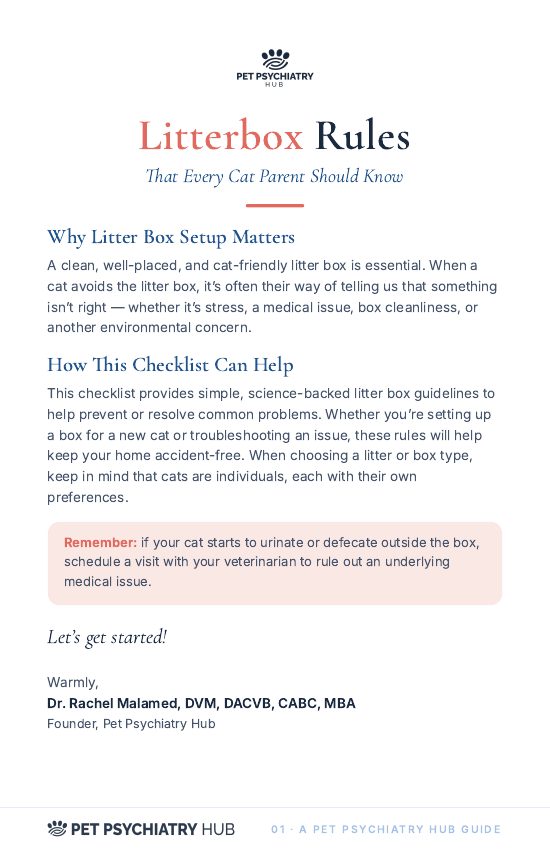
Free companion guide
Litterbox Rules Every Cat Parent Should Know
Science-backed setup rules that prevent most house-soiling problems.
Get the free guideThe setup mistakes I see most
When the cause is the box itself, it is usually one of a small number of things, and correcting them frequently resolves the case with no behavior work at all.
- Too few boxes. The working rule is one per cat plus one, in separate locations. Two boxes side by side is one box in the cat’s assessment.
- Too small. The box should be about one and a half times the cat’s body length, which most commercial boxes are not.
- Covered. Hoods concentrate odor and, critically, create a space with a single exit, a serious problem in a multi-cat household.
- Bad location. Next to a washing machine, in a busy corridor, or anywhere the cat can be cornered while using it.
- Wrong litter. Most cats prefer a fine, soft, unscented clumping litter at a depth of about three to four centimeters. Scented litters are marketed to pet parents, not cats.
- Not clean enough. Scoop at least daily. A cat’s standards are considerably higher than most people assume.
- Over-cleaned with the wrong thing. Ammonia-based cleaners smell like urine to a cat and actively invite repeat use.
Why punishment makes it worse
Shouting, nose-rubbing, and confining the cat to the room with the box all share a mechanism: they raise the cat’s stress level. Since stress is a direct cause of feline idiopathic cystitis and a direct cause of marking, punishment tends to worsen exactly the thing it is aimed at.
Cats do not soil the house out of resentment. They do it because something hurts, something has changed, or something about the box is unacceptable to them.
One thing you can do this week
Run a litter box café. Put out several boxes side by side, each with a different litter, fine clumping, coarser clay, paper-based, sand-like, all unscented, all uncovered, all clean. Then note which one your cat uses over the following week.
You stop guessing at your cat’s preference and simply observe it. It is the single most informative week of work available to a cat parent with this problem, and it costs almost nothing.
When it is social rather than physical
If the medical workup is clean and the setup is right, the remaining cause is usually social. Multi-cat households run on invisible resource geography, territory, routes, vantage points, and access to the things that matter. A cat who is being blocked from the box by another cat, or who has lost confident access to part of the home, will find somewhere else to go.
Resolving that means mapping the household properly: where each cat spends time, where the tension points are, and how to give every cat independent access to food, water, resting places, and toileting without needing to pass anyone. That is a longer piece of work than a litter change, and it is the point at which a consult tends to be worth it.
© 2026 Rachel Malamed, DVM · Pet Psychiatry Hub. This content may not be reproduced without permission.